Video Analytics 101: Why It Matters & How to Pick a Winner
June 30, 2025
If you’re in Singapore or have any sort of interest in aviation, you’ve probably heard the recent news. The world’s greatest place to fly, Changi Airport, is practically doubling in size with the construction of its 5th terminal.
It’s a huge effort that will take a decade, employ thousands, and rely on potentially up to 1400 cameras all around its worksite. Those cameras will stream into Ailytics’s video analytics platform to transform raw video into real-time safety and productivity insights.
How did Ailytics get chosen for this monumental project?
Video analytics is a developing and complex space, and there are many factors aside from price to consider. Whether you’re building an airport or something much smaller, it’s important to do your due diligence when you’re selecting a solution provider.
Wait, what is video analytics (VA) anyways? Why would I need it?
At a high level, video analytics uses artificial intelligence to understand what’s happening in a video. It can be used to count, track, or identify objects such as people or machines. More complex VA models are able to evaluate situations, such as recognizing if someone is standing under a suspended load.
These are all things that humans can do as well; but not at scale. It’s easy to watch a short video clip and understand everything that has happened. However what happens when a short video clip becomes 24/7 live footage, and not just one but dozens of different camera angles?
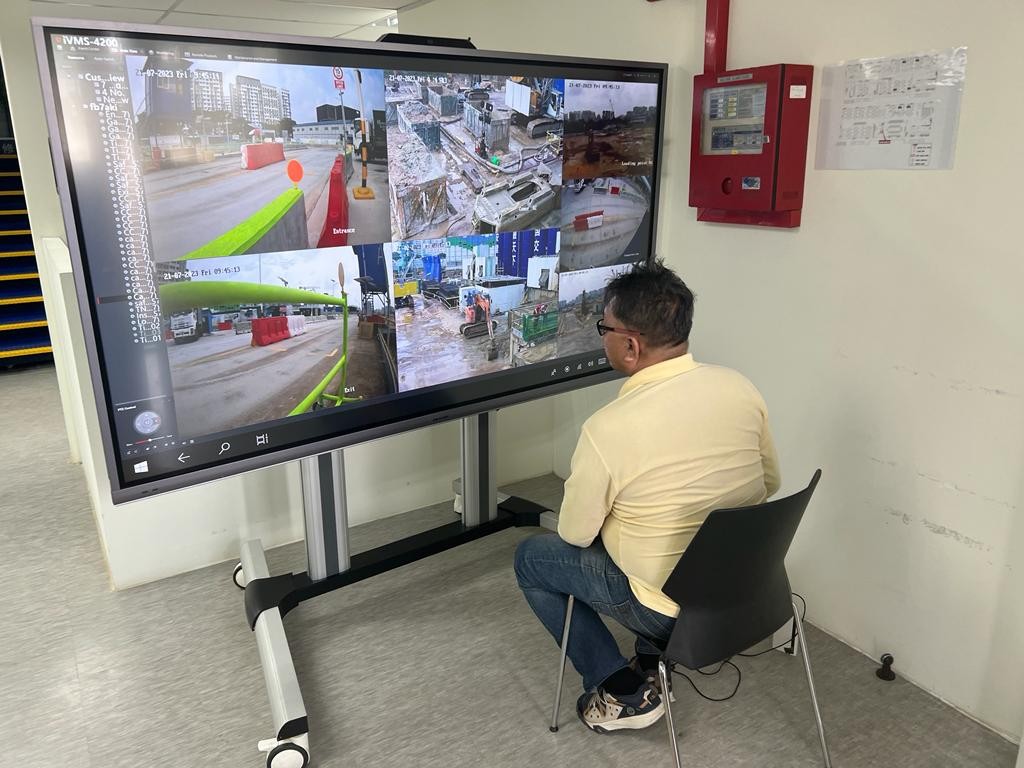
A common scene In a traditional construction site. A safety supervisor attempting to manually monitor multiple camera feeds at once. Things get overlooked.
When you have lots of video footage, and there’s a need to understand or react to it, VA becomes the best solution. It’s just a matter of picking the right one. Here are eight tough questions that you should consider asking every company:
1. What industries are you specialised in? Why those industries?
Video analytics isn’t something that’s brand new. Basic VA solutions that can count people, identify fruit, or detect intruders for instance have been around for nearly two decades. There are university students today that can build their own rudimentary VAs.
However not all VAs are the same. When it comes to video analytics (and AI) models in general, training is required in order for it to work properly. A VA model can develop a specialization depending on the type of data that it ingests. Models that are trained solely on photos of animals for instance will become really good at identifying animals, but perhaps not much else.
You can find general purpose datasets online, but developing a highly accurate specialization will require proprietary data that has to either be self-collected or accessed through close industry partnerships. Make sure to ask companies about their specializations, and how they developed them exactly.
At Ailytics, we’re specialized in industrial sectors such as construction and manufacturing. We have one of the largest proprietary industrial datasets available; stemming from our 220+ projects worldwide and from our R&D with HDB since 2019. Our platform can be used in other sectors, but it truly excels in understanding everything industrial.
2. What projects have you worked on?
Ask companies for their project history. It’s very easy for anybody to make bold claims about the effectiveness of their platform, but has it ever been tested in a real world environment? What were the actual results?
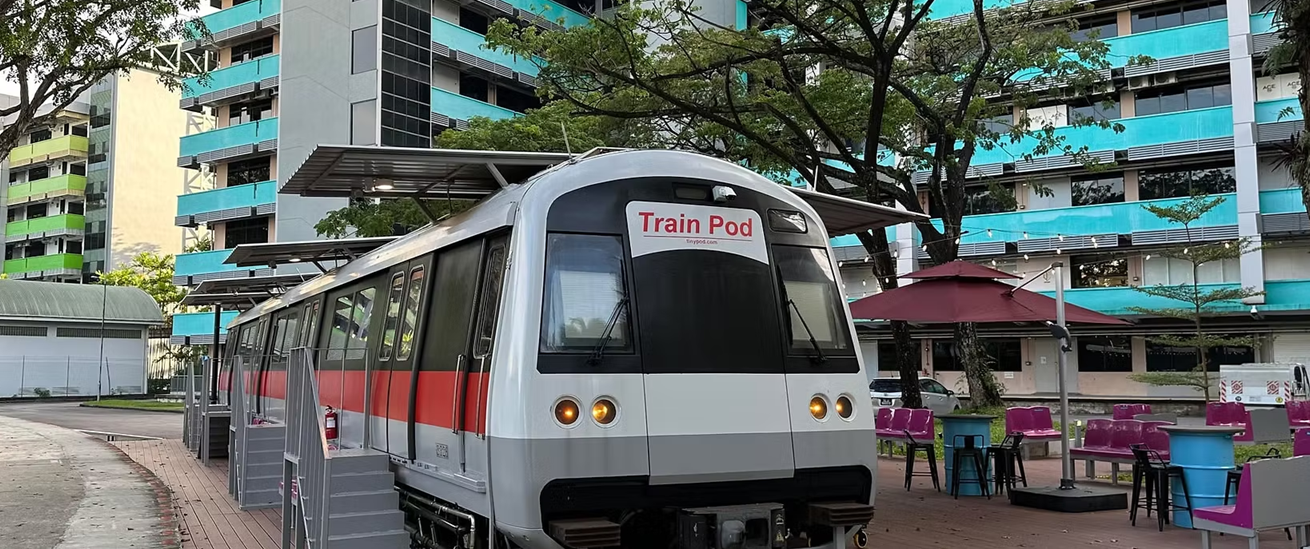
In our hometown of Singapore, we’ve currently deployed to some of the largest construction projects in the country. We’re at the sites of Changi’s Terminal 5, NS Square at Marina Bay, and Punggol Digital District. We’ve also been deployed to smaller niche projects such as Singapore’s first train-inspired hotel.
Powered by Ailytics for crowd-control and crisis detection. Photo credit - Tinypod
3. How high is your accuracy and reliability in the field?
Let’s say you’re building a VA model for construction, and you have a decent amount of proprietary training data. You might think that you’re all set, but there’s still also the challenge of real world optimization.
It’s easy for any VA solution to achieve a high accuracy in an ideal scenario. HD cameras, close-up shots, great lighting, and clean environments are a recipe for success. However in real world situations, this is rarely the case.
Take your average construction site for instance. They might not have the highest quality cameras, and those cameras might be positioned at very long ranges. When you also factor in all sorts of weather, connectivity, and lower light conditions, accuracy can take a complete nosedive.
At Ailytics, we’re constantly planning for this. We utilize unique pre and post processing techniques to give our model the best chance in any possible scenario. When it comes to video analytics, we believe that any accuracy under 70% is essentially equal to 0%.
We’re proud to maintain an accuracy standard between 80-95% across all of our projects; not just at our office.
4. What can you do differently than the competition?
Video analytics has not developed to the point where it has become a commodity. Even for those that are specialised within the same industries, VA solutions can greatly differ in terms of accuracy, requirements, and features. It’s easy for anybody to say they’re better, but you need to ask how specifically.
For us, one of our main differentiators is our patented understanding of 2D vs 3D spaces. Most VA systems analyze video in a 2D format. In order for a system to calculate depth within a scene, multiple cameras or LIDAR sensors are usually required. We have patented technology that allows a singular camera angle to be transformed into 3D, allowing for accurate distance, height, and proximity calculations.
5. What are the technical requirements for your solution?
Finding a great VA solution is one thing, deploying it is another. In order to use a VA solution on a site, you need cameras and a way to connect to those cameras.
Sometimes the technical requirements can be higher than you realize. Some solutions may work very well, but only if you have advanced high resolution cameras. These cameras are not just more expensive, but they can often put more strain onto your network bandwidth. Higher strain can in turn mean more costly network equipment, or susceptibility to connectivity issues.
Our approach at Ailytics is to be as flexible as possible. We’re able to accommodate both cloud and on-prem deployments, and we don’t require specialized cameras to work properly. Resolution as low as 2MP and we’re good to go.
6. How flexible is your implementation?
Once you have a VA system implemented, what can you actually do with it? Video analytics is a field that has a lot of inherent variables and use cases. Are you able to finetune parameters to fit your exact need? Is the system able to detect a specific problem that you have? Can you customize alert frequencies to prevent spamming for your team?
We’ve identified and trained our Ailytics system on 30+ of the most common industrial safety and productivity scenarios. We recognize that every situation is different, and we allow for configuration of the smallest things.
7. How do you handle post-sales customer support?
It’s not always smooth sailing when it comes to VA, especially when it’s being used in industrial settings. To keep it simple - things can and will go wrong. Cameras may break, power outages could occur. Sometimes there’s just an unexplainable computer glitch. What then?
At Ailytics, we take pride in our responsiveness. Something goes wrong, we’re there. Every one of our customers are supported by a personal Customer Success Engineer, along with a dedicated day and night team IT support team.
8. How much do you cost?
The biggest question of all. The price matters, but there’s always an additional hidden cost behind every solution. Consider all the factors:
Are there additional hardware costs associated with the solution?
Are there any hidden software costs; such as limits on the number of users, or reports you can generate? (unlimited with Ailytics)
What were some tangible results of VA for a similar project to yours?
Am I signing up for a solution that’s still evolving, or am I getting something that’ll be outdated in a year’s time?
These aren’t easy questions that you can find out on your own. Let us help you answer them - contact us for a demo today!
.png)